Aerial Freedom at the Final Hour
The Poem
About the Poem
In A Wish Poem, Matthew Arnold imagines his own deathbed scene with striking clarity and defiance, rejecting the conventional trappings of grief and medical ceremony. He does not ask to be free of greedy heirs or tearless mourners, but instead requests a quiet, solitary end—one that grants him the freedom life denied. The mood is calm yet resolute, as Arnold contrasts the “hideous show” of a crowded, gloom-filled room with a serene vision of nature. His final wish is to gaze from a window at the wide landscape, bathed in morning dew, and feel himself wed to the eternal world that existed before his birth and will continue after. The stakes are personal and philosophical: to escape the turmoil of human combat with death and instead embrace the pure, generous course of life itself, becoming one with the universe.
About the Music
Silas Vale's "The Window at Dawn" is a contemplative ambient soundscape that unfolds at a gentle 110 BPM, built from slow, evolving synth pads and sparse piano notes drenched in long reverb. Distant field recordings of morning birds and a deep, resonant drone that swells subtly create a texture like mist clearing from a quiet landscape. The piece evokes the serene, spacious feeling of first light, with a mood of peaceful introspection and no percussion to disturb its calm. Fans of Brian Eno's ambient works or the atmospheric depth of Stars of the Lid will recognize this careful balance of stillness and gentle motion, where each element breathes slowly, inviting the listener into a moment of quiet awakening.
About the Art
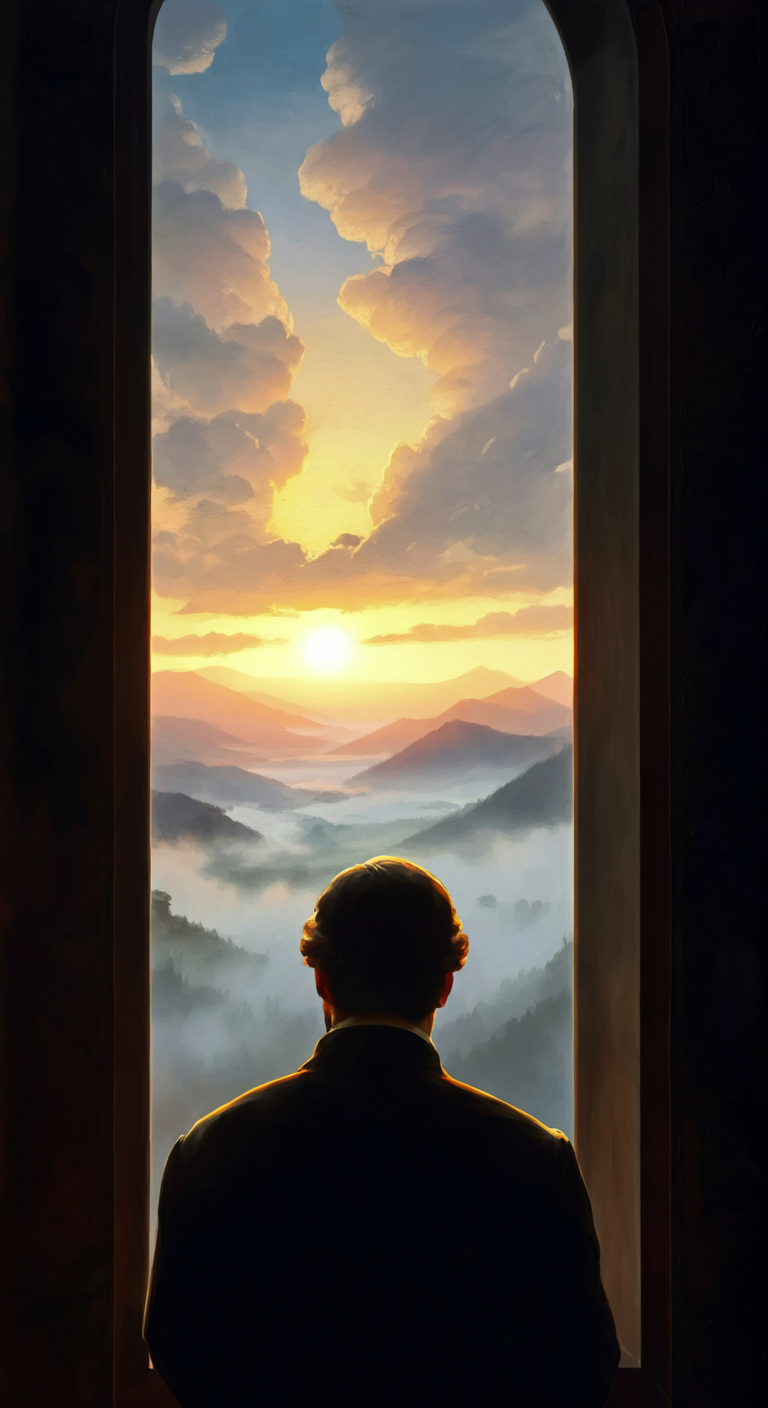
Elias Thorne’s *The Last Landscape* is a masterwork of Romanticism, capturing the sublime tension between interior solitude and nature’s overwhelming grandeur. Viewed from a dim room, the composition places the viewer behind a man’s silhouette—his shoulder and head in the lower right foreground, gazing outward. The upper two-thirds of the vertical canvas open onto a vast misty valley bathed in soft, diffused dawn light. A golden glow on the horizon transitions from cool blues and grays in the foreground shadows to warm golds, pinks, and soft yellows in the distant sky. Thorne’s visible, expressive oil brushstrokes animate the clouds and mountain forms, evoking the emotional depth of Caspar David Friedrich. The painting’s mood is one of contemplative awe, balancing human frailty against nature’s eternal beauty, with light and texture guiding the eye toward the luminous focal point on the horizon.