Handyman
The Poem
About the Poem
Frank Banta’s science fiction poem Handyman traps a lone prisoner, James Ypsilanti, inside an impenetrable cell with a cheerful but strictly rule-bound carpenter robot. Jim endlessly chops hardwood doors, builds fires, and eats from cans while the robot refuses to fix the heating plant, insisting that inmates get no help. The stakes escalate when a world war erupts and all of Earth evacuates via matter-transmitters, but the prison’s steel-and-rock walls block the signal, leaving Jim and the robot stranded as the last humans. The mood is bleak and absurd, blending grim survival with the robot’s maddening, cheerful adherence to protocol. Jim’s desperate attempts to reason with the machine fail as it wanders off to find another door, obeying its programming even in a dead world. Banta explores isolation, the limits of artificial loyalty, and the hollow irony of rules that outlast humanity itself.
About the Music
Static Horizon’s Frozen Circuits, Empty Sky is a masterwork of dark ambient industrial that conjures a post-apocalyptic wasteland of ice and silence. At a glacial 60 BPM, the track unfolds with cold, sparse synths and a slow pulsing bass that feels like the heartbeat of a dying machine. Distant metallic echoes ring across a frozen landscape, while minimal piano notes fall like solitary snowflakes, each one a fragile memory of warmth. The mood is desolate and isolated, evoking the loneliness of a lone survivor navigating the ruins of civilization. The sonic palette recalls the stark minimalism of Lustmord’s deepest drone works and the industrial decay of early Nine Inch Nails instrumentals, but Static Horizon carves out a uniquely frigid space. This piece is not just heard but felt as a chilling breath against the skin, a soundtrack for wandering through a world where the sky is empty and the circuits have gone cold.
About the Art
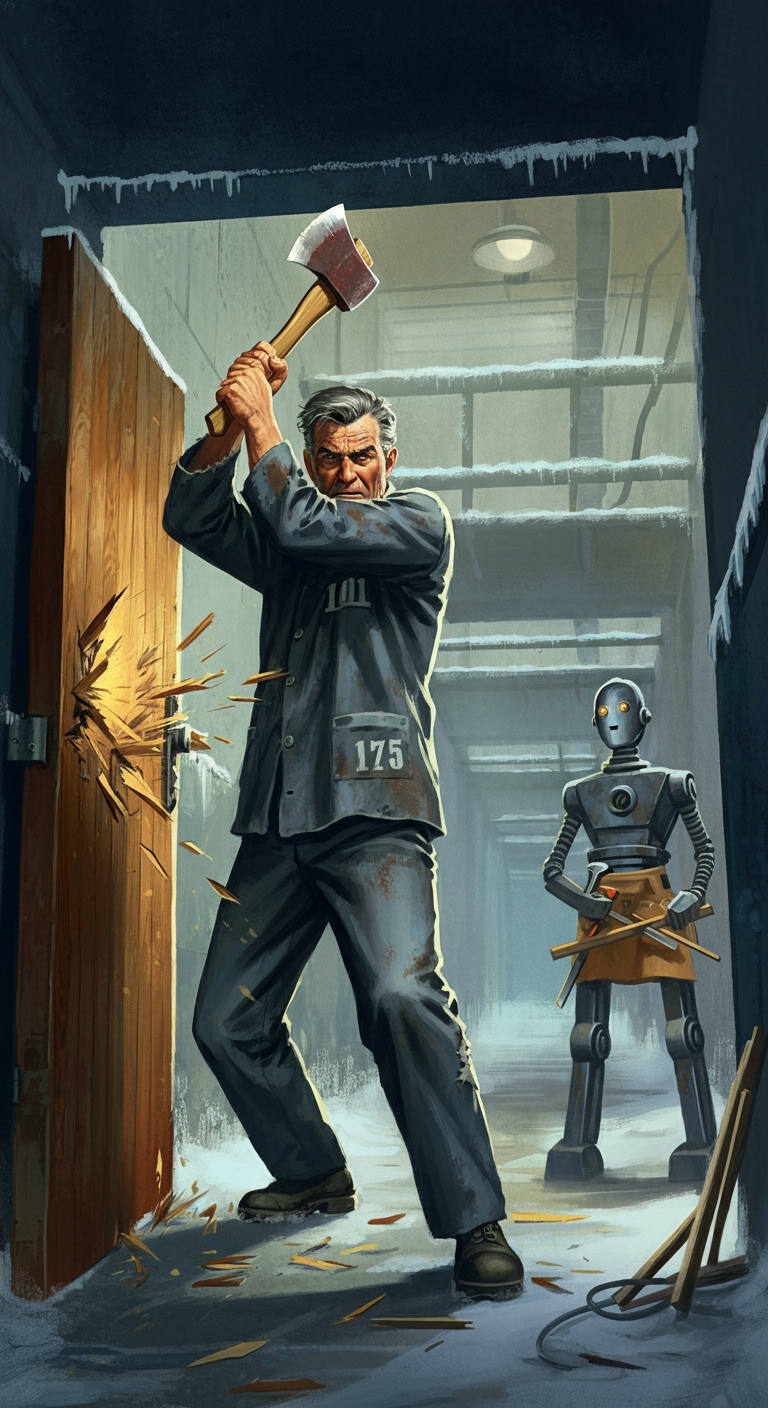
In Viktor Kowalski's painting The Last Handyman, a weathered middle-aged man in a tattered prison uniform swings a hatchet at a hardwood door, splinters exploding outward as his breath fogs in the freezing air. He stands in a desolate concrete prison hallway, where broken heating vents line the walls and frost creeps along the metal. Behind him, a humanoid carpenter robot with a blank metallic face watches with an eerily cheerful posture, holding carpentry tools. The composition places the man prominently in the upper-center frame, while harsh overhead industrial lighting casts cold, stark shadows across the scene. Kowalski employs a muted palette of gray, rust, and cold blue, evoking the vintage pulp cover art aesthetic of 1960s retro science fiction illustration. The desolate, post-apocalyptic mood recalls classic magazine covers by artists like Frank Frazetta or Ed Emshwiller, merging gritty survival with unsettling robotic cheer.