The Enchanted Way and the Fallen Leaf
The Poem
About the Poem
In Patrick Kavanagh’s On Raglan Road, a speaker recalls the autumn day he met a dark-haired woman, sensing from the start that his love for her would bring future pain, yet he willingly walked the enchanted path. The poem shifts to a November scene on Grafton Street, where the couple moves along a precarious ledge, suggesting the risk and fleeting intensity of passion. Though he gave her his deepest artistic gifts—poems, secrets of the mind—he admits he loved too much, and that excess doomed their happiness. The mood is bittersweet and regretful, tinged with the ache of lost innocence. The speaker now sees her walking away on a quiet street, and his reason must accept that he wooed a mortal woman as if she were an angel, a mistake that cost him his wings. The stakes involve the painful collision between idealised love and human reality.
About the Music
Eamon Byrne's Autumn Lament is a melancholic acoustic folk piece that evokes the quiet decay and bittersweet nostalgia of the season. At a reflective 68 BPM, the composition centers on a fingerpicked Irish bouzouki, whose delicate patterns are underpinned by soft, sustained cello drones and a sparse bodhrán rhythm that barely whispers in the background. A mournful tin whistle melody emerges in the interludes, its notes draped in subtle reverb that creates a spacious, memory-laden atmosphere. The arrangement feels deeply rooted in Celtic folk traditions, yet its restrained, cinematic quality recalls the introspective storytelling of artists like Nick Drake or the ambient folk of早期的 Pentangle. Autumn Lament invites listeners into a quiet, windswept landscape where each note lingers like a falling leaf, capturing the beauty of loss and the passage of time with gentle, aching precision.
About the Art
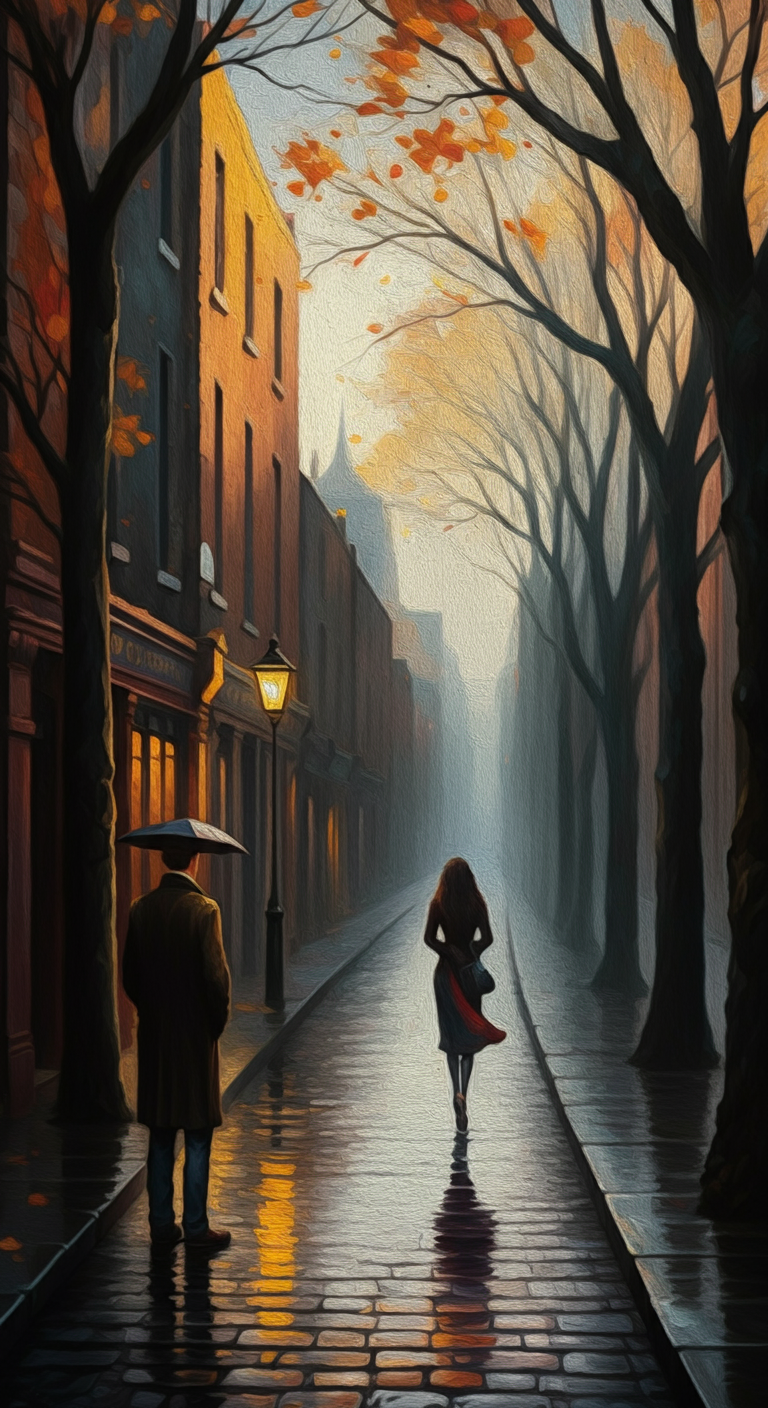
Siobhan Ní Dhomhnaill’s Ghosts on Grafton Street is a vertical Romanticism oil painting that evokes a sense of longing and the sublime through soft, diffused late autumn light and long dramatic shadows. The composition places a man on the left third of the frame, gazing toward a dark-haired woman on the right third, who is slightly out of focus as she hurries down a wet, cobbled Dublin street lined with bare trees. The muted palette of browns, ochres, and greys is punctuated by the woman’s dark hair and a single vibrant red leaf, while visible, expressive brushstrokes create a blurred, dreamlike quality. This atmospheric scene, where “old ghosts meet,” recalls the emotional intensity of Caspar David Friedrich, emphasizing memory and the fleeting nature of connection.