The Everything Left Behind
The Poem
About the Poem
Simon Armitage’s About His Person Poem presents a stark inventory of a dead man’s possessions, each item a clue to a life abruptly ended. The scene is a post-mortem examination of pockets, where a library card, an unwritten postcard, a diary slashed with a pencil, and a stopped watch tell of plans abandoned and time cut short. A final demand in his own hand and a rolled note of explanation, described as a beheaded carnation, suggest a deliberate, perhaps sorrowful departure. The mood is clinical yet deeply poignant, shifting from mundane details—a shopping list, a locket with a photograph—to the haunting absence of a wedding ring, replaced only by a band of unweathered skin. The stakes are intimate and universal: the gap between what a person carries and what they leave behind, and the quiet tragedy of a life reduced to a list of objects that cannot speak.
About the Music
Elias Wainwright’s The Pavement’s Gaze is a somber modern classical work that unfolds at a slow, deliberate tempo, evoking the quiet isolation of a rain-slicked street after midnight. The piece is built around a melancholic piano melody, its sparse notes falling like footsteps on wet asphalt, while deep, resonant cello notes provide a grounding, mournful foundation. A distant, unsettling high violin string motif hovers overhead, suggesting an unseen observer or a lingering memory. The composition recalls the minimalist, emotionally charged atmosphere of composers like Max Richter or Ludovico Einaudi, yet Wainwright’s use of space and tension is distinctly his own. The piece concludes abruptly with a single, sharp percussive sound—like a door slamming shut or a heel cracking on stone—that shatters the reverie, leaving the listener with a jolt of unresolved anxiety.
About the Art
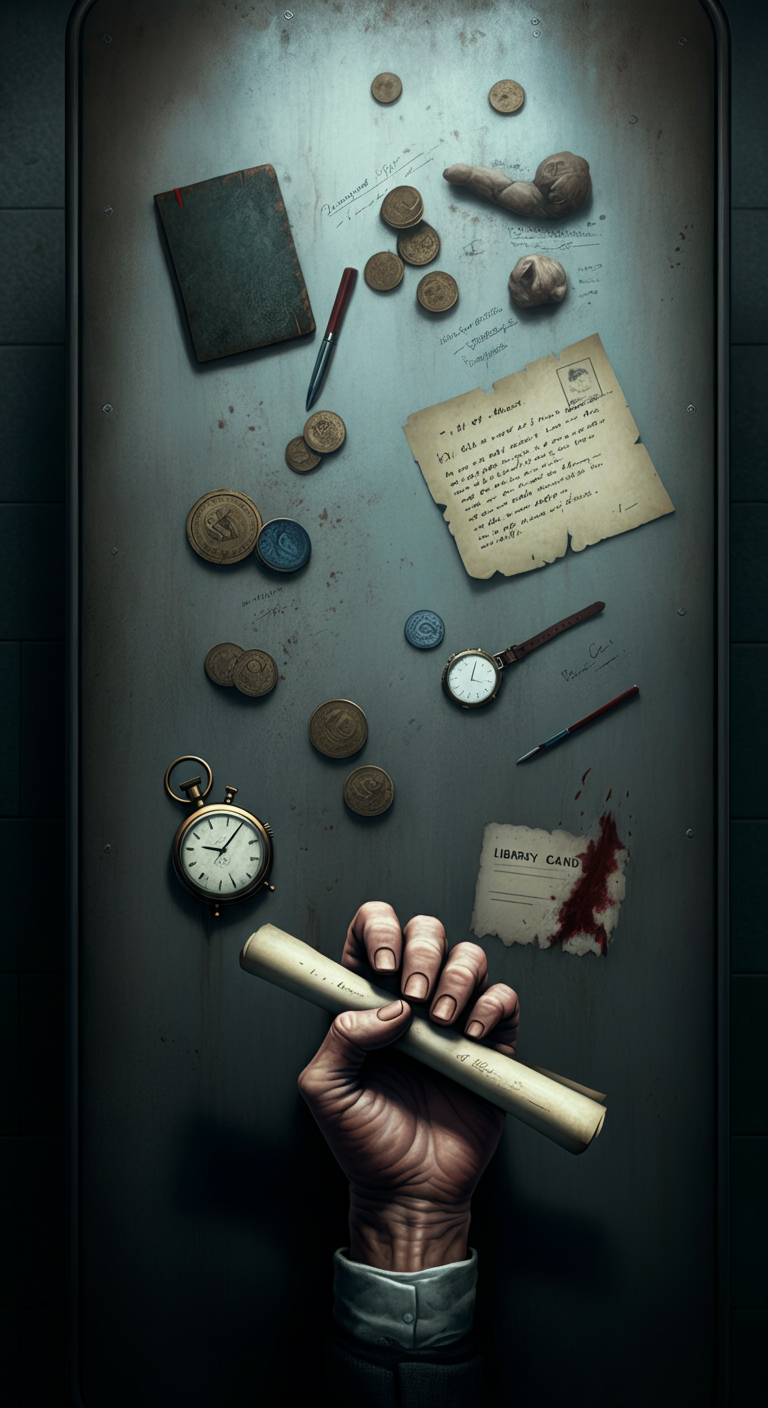
Elias Vane’s photorealistic digital painting Post-Mortem Inventory adopts a forensic, documentary style to scrutinize the final possessions of an unseen deceased. Bathed in harsh clinical overhead fluorescent light that casts sharp shadows across a steel mortuary table, the composition centers on a close-up, top-down view. The primary focal point is a man’s pale hand, clenched in a fist and holding a rolled note, positioned in the lower right third of the frame. Surrounding it with sterile precision are personal effects: coins, a stopped watch, a library card, a postcard, and a slashed diary. Vane employs a desaturated palette of steel grays, concrete whites, and muted blues, with the only warmth emanating from the lifeless hand’s skin tones. The hyper-detailed digital render emphasizes the textures of crumpled fabric, aged paper, and cold metal, evoking the meticulous, detached observation of a crime scene photographer. The mood is one of clinical melancholy, focusing entirely on objects and the telling hand, leaving the face out of frame.