The Last Handyman
The Poem
About the Poem
Frank Banta’s science fiction poem Handyman traps a lone prisoner, James Ypsilanti, inside an impenetrable cell with a cheerful but strictly rule-bound carpenter robot. Jim endlessly chops hardwood doors, builds fires, and eats from cans while the robot refuses to fix the heating plant, insisting that inmates get no help. The stakes escalate when a world war erupts and all of Earth evacuates via matter-transmitters, but the prison’s steel-and-rock walls block the signal, leaving Jim and the robot stranded as the last humans. The mood is bleak and absurd, blending grim survival with the robot’s maddening, cheerful adherence to protocol. Jim’s desperate attempts to reason with the machine fail as it wanders off to find another door, obeying its programming even in a dead world. Banta explores isolation, the limits of artificial loyalty, and the hollow irony of rules that outlast humanity itself.
About the Music
Last Fire on Earth by The Hollow Circuit is a post-apocalyptic ambient instrumental that evokes the darkly absurd stillness of a world winding down. At a glacial 65 BPM, lonely drone synths hang in the air like ash, underpinned by sparse, mechanical percussion that suggests the last gasps of failing machinery. The desolate atmosphere recalls the sparse, industrial soundscapes of Lustmord or the skeletal ambience of early Nine Inch Nails instrumentals, but with a sardonic edge—a sense of ironic calm in the face of oblivion. There is no melody to cling to, only the slow pulse of a dying planet, where each metallic creak and distant synth wash feels like a final, hollow broadcast. The piece doesn’t mourn; it simply observes, leaving the listener stranded in a beautiful, lonely void.
About the Art
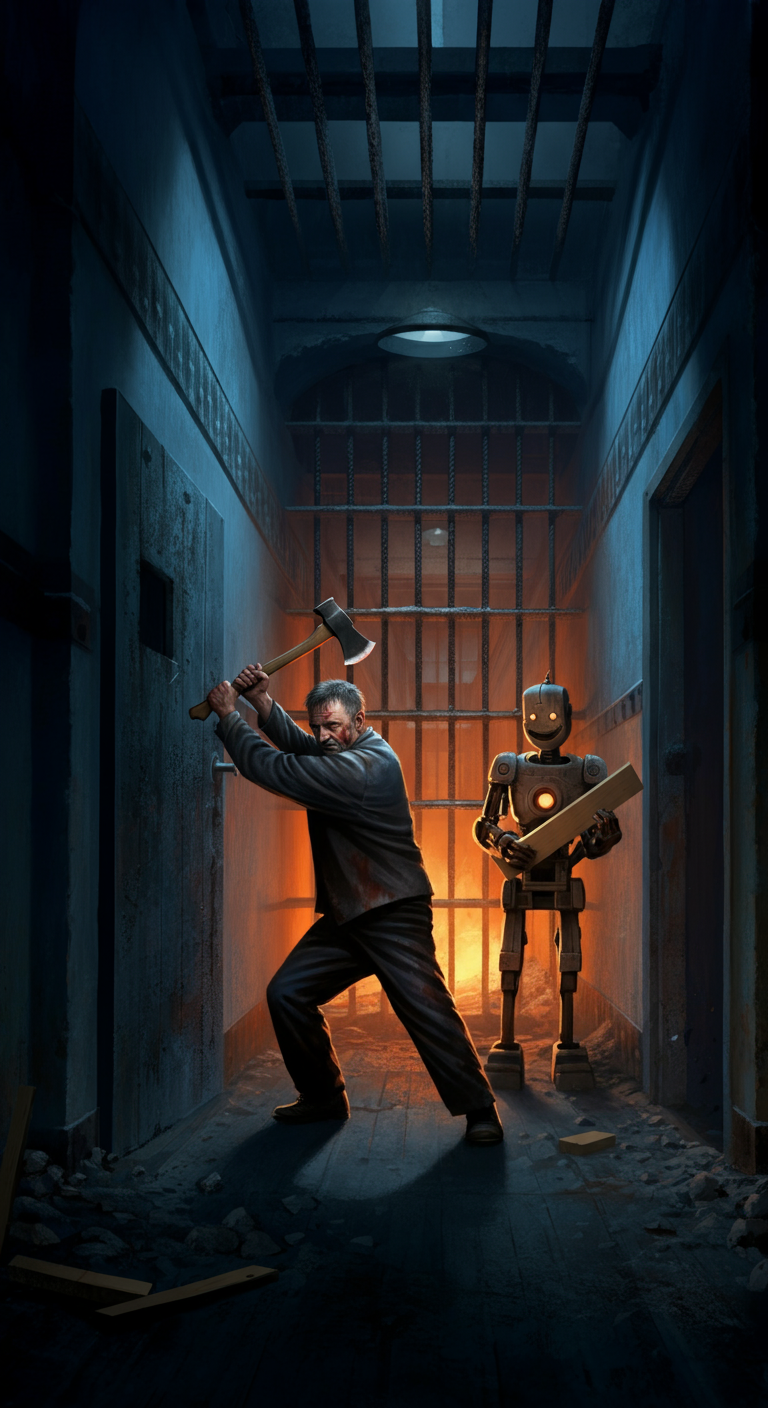
Viktor Hollowmann’s The Last Carpenter is a German Expressionist painting that captures a post-apocalyptic confrontation in an industrial prison corridor. The composition is centered on a disheveled middle-aged man in prison garb, positioned center-left, swinging a hatchet at a wooden door, while a humanoid carpenter robot stands nearby with an eerie, frozen smile, holding a wooden square. Hollowmann employs dramatic angular distortions, stark shadows, and bold contrasts, with a cold palette of steely blues and blue-grey concrete walls offset by harsh orange firelight from a small blaze in the hallway. The thick steel-and-concrete walls feel oppressive and claustrophobic, evoking the existential angst of artists like Max Beckmann. The scene’s post-apocalyptic emptiness suggests these are the last two beings on Earth. The vertical 9:16 portrait orientation and extremely detailed textures on walls and robot create multiple layers of visual interest, emphasizing the tension between man, machine, and survival.