This Way to the Egress
The Poem
About the Poem
Andrew Fetler’s narrative work “This Way to the Egress” drops the reader into a quiet, menacing village where a man sits in a kitchen, drinking coffee that smells of iodine while Mrs. Tilton serves him. The mood is one of creeping dread and resignation, as the man has been hearing a child’s voice that leads nowhere, and his search reveals a hidden telegram ordering a lethal procedure if the voices persist. The stakes are life and death, yet the poem resists melodrama. Instead, it follows the man as he chooses to stay inside, shell peas with his captor, and die peacefully, counting peas on his tongue. The scene balances the surreal horror of institutional control with the quiet dignity of a final, simple act. Fetler uses domestic details—lilacs, radish leaves, a hand pump—to ground the terror in ordinary life, making the ending both chilling and strangely tender.
About the Music
Evening Lament’s Pasture at Dusk is a pastoral ambient piano instrumental that evokes the quiet acceptance of an ending. At a slow 60 BPM, the piece unfolds with minimalist, gentle piano lines floating over soft ambient pads, creating a haunting yet peaceful atmosphere. The mood is one of gentle melancholy, reminiscent of the serene, contemplative works of composers like Harold Budd or the ambient textures of Brian Eno’s Music for Films. This piece suggests not sorrow, but a serene stillness at the close of a long day, capturing the essence of end-of-life tranquility. The sparse notes and spacious arrangement allow for deep reflection, making Pasture at Dusk an ideal soundtrack for moments of calm introspection or meditative solitude, where the fading light brings a sense of solemn beauty and final peace.
About the Art
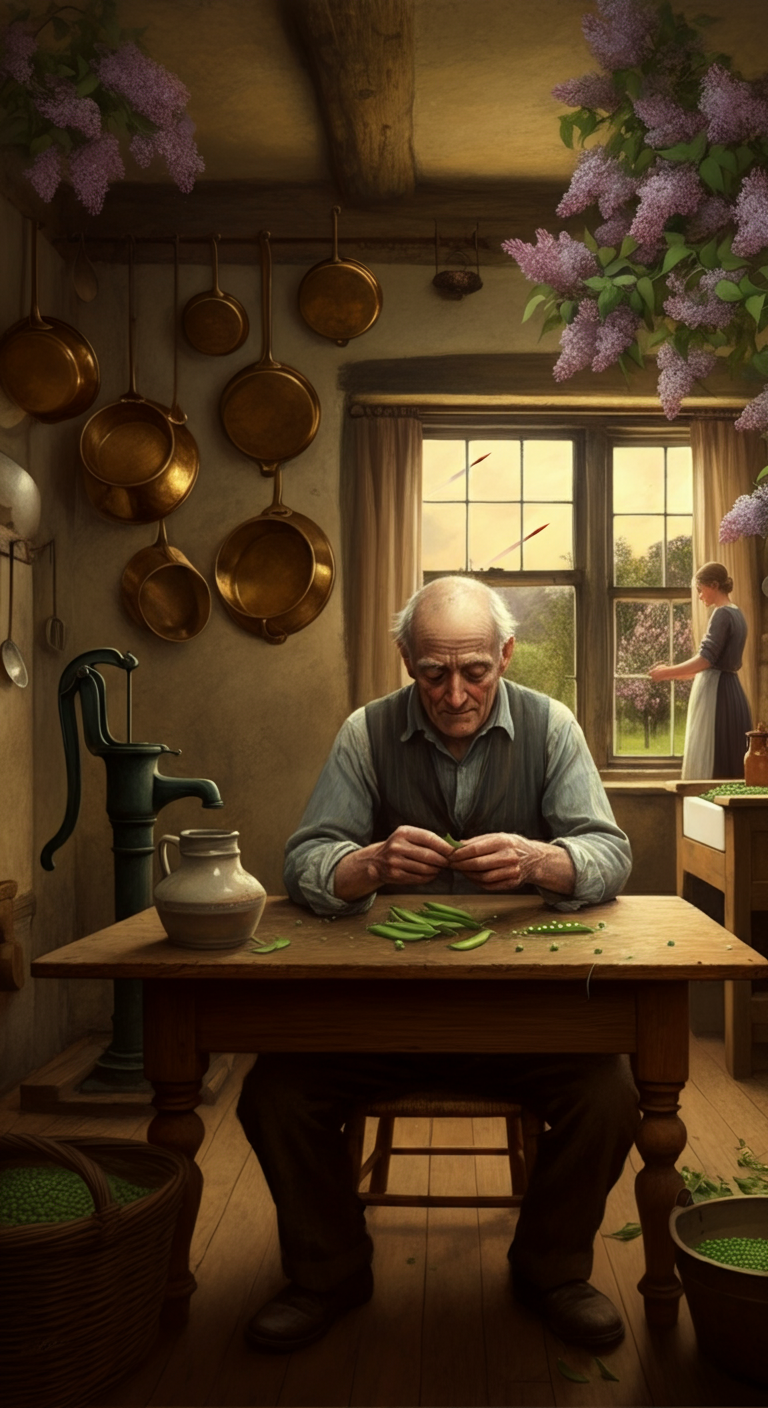
Clara Finch’s “This Way to the Egress” is a muted realism painting in the style of Andrew Wyeth, capturing an elderly man with trembling hands seated at a worn wooden table, shelling peas in an English country kitchen. His face is peaceful yet haunted, surrounded by brass pots, flagstones, and an antique hand pump. A woman in simple dress stands nearby, while lilacs bloom outside a small, slightly blurred window. Through that window, a white rocket trail scratches across a darkening sky, introducing a quiet tension. The composition balances intimate domestic detail with a distant, melancholic horizon. Color is restrained to muted browns, ochres, grays, and subtle greens, with fading golden light that deepens the mood of serene acceptance and end-of-life reflection. The technique is extremely detailed, emphasizing texture and atmosphere.