Washed-Up on Shore with a Cat
The Poem
About the Poem
Charles Bukowski’s “Are You Drinking?” captures a moment of raw, weary introspection from a speaker confined to his bed, a yellow notebook in hand. The scene is set in a motel room where the poet, an aging writer, reflects on his physical decline—weak legs, vertigo, and back pain—and anticipates a doctor’s visit that will inevitably probe his habits. The mood is one of quiet resignation and existential boredom; even the horse track, once a source of thrill, now feels meaningless. The stakes here are not dramatic but deeply human: the struggle to find purpose amid the “stale yet fluctuating factors” of life. Bukowski’s blunt, conversational tone lays bare a man grappling with the mundane weight of existence, finding only fleeting solace in his craft and the small, grounding presence of his cat. The poem’s power lies in its unflinching honesty about aging, loneliness, and the search for meaning in the ordinary.
About the Music
Elias Wainwright’s The Pavement’s Gaze is a somber modern classical work that unfolds at a slow, deliberate tempo, evoking the quiet isolation of a rain-slicked street after midnight. The piece is built around a melancholic piano melody, its sparse notes falling like footsteps on wet asphalt, while deep, resonant cello notes provide a grounding, mournful foundation. A distant, unsettling high violin string motif hovers overhead, suggesting an unseen observer or a lingering memory. The composition recalls the minimalist, emotionally charged atmosphere of composers like Max Richter or Ludovico Einaudi, yet Wainwright’s use of space and tension is distinctly his own. The piece concludes abruptly with a single, sharp percussive sound—like a door slamming shut or a heel cracking on stone—that shatters the reverie, leaving the listener with a jolt of unresolved anxiety.
About the Art
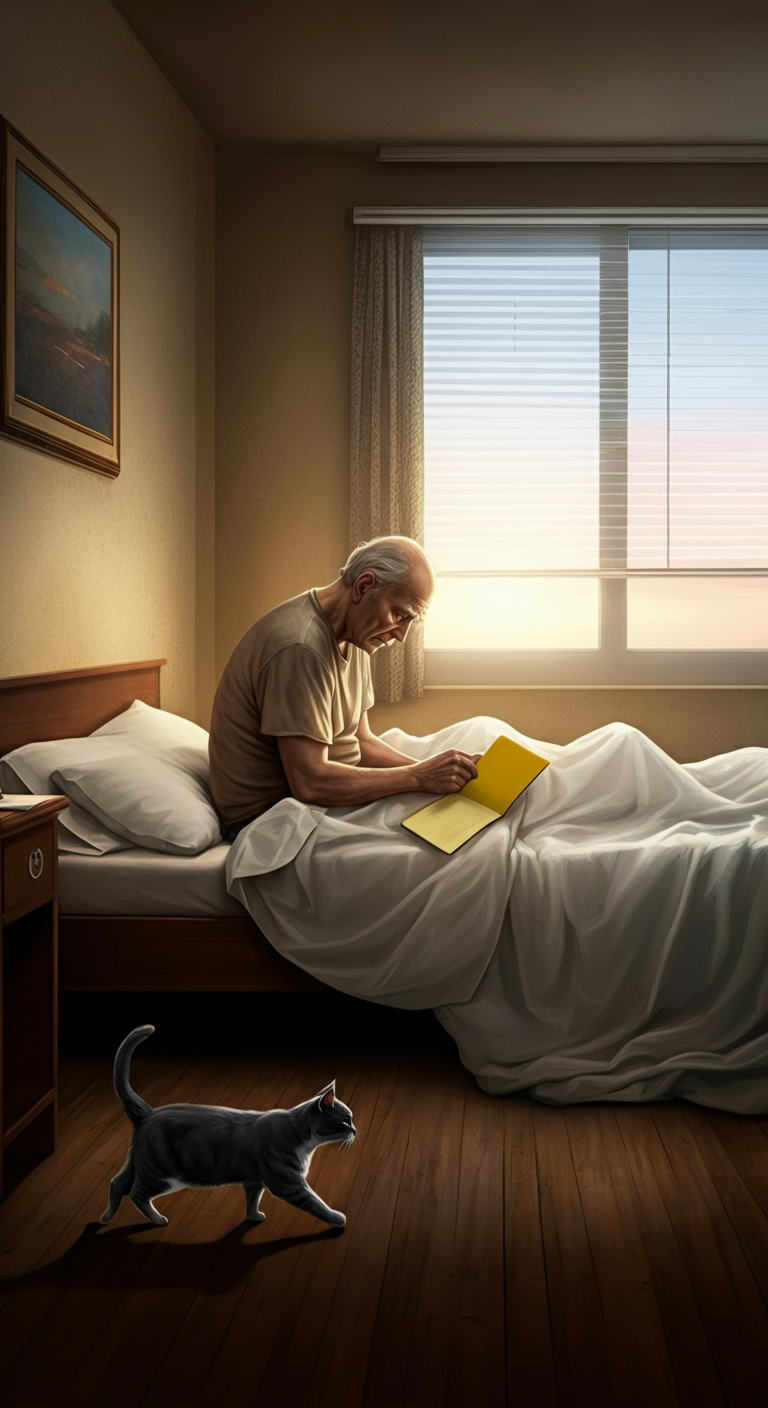
In Elena Voss's contemporary realist painting, *The Old Yellow Notebook*, a weary old man in a worn t-shirt reclines against pillows on an unmade bed, clutching a yellow notebook. The vertical composition guides the eye from the rumpled white sheets at the bottom, across scuffed wooden floorboards where a grey cat approaches from the left, up to a drab beige motel wall. A cheap painting hangs slightly crooked beside a window with half-closed blinds, through which flat afternoon light falls horizontally across the scene. The muted palette of beige, grey, and white, punctuated by the notebook's yellow, evokes a quiet, melancholic mood. Voss’s precise, realistic technique and careful attention to domestic detail recall the intimate, worn interiors of Edward Hopper, capturing a moment of solitude and reflection in a transient space.