Where Are You, God's Spirit?
The Poem
About the Poem
In Kahlil Gibran’s “A Lover’s Call Xxvii Poem,” a speaker desperately searches for a beloved who has become a divine, almost ethereal presence. The lines weave through imagined scenes—watering flowers in paradise, praying in a temple, or reading among books—while grounding the search in vivid memories of their first meeting, shaded walks, and a farewell kiss that revealed heavenly secrets. Gibran blends earthly longing with spiritual yearning, portraying love as a force stronger than time and capable of unlocking the soul’s deepest truths. The mood is reverent and aching, hovering between joyful recollection and the loneliness of separation. The speaker’s stakes are immense: they are not merely missing a person but seeking a soul-companion who embodies God’s spirit everywhere, and whose kiss became an initiation into a timeless, spiritual world where their reunion will be eternal.
About the Music
Elias Vance’s Elegy for the Beloved is a haunting Ambient Classical composition that unfolds at a slow, deliberate tempo, built around a solo cello melody that aches with melancholic beauty. The cello’s deeply resonant lines are supported by soft, distant piano chords and ethereal, floating strings, creating a spacious and yearning atmosphere that evokes a sense of profound loss and gentle remembrance. The piece conjures the emotional weight of a farewell, yet retains a fragile, luminous quality, reminiscent of the minimalist, introspective works of composers like Arvo Pärt or Max Richter. Vance masterfully balances solitude and expanse, allowing each note to breathe in a quiet, cinematic soundscape that feels both personal and universal, making it an ideal piece for reflective listening or contemplative scenes.
About the Art
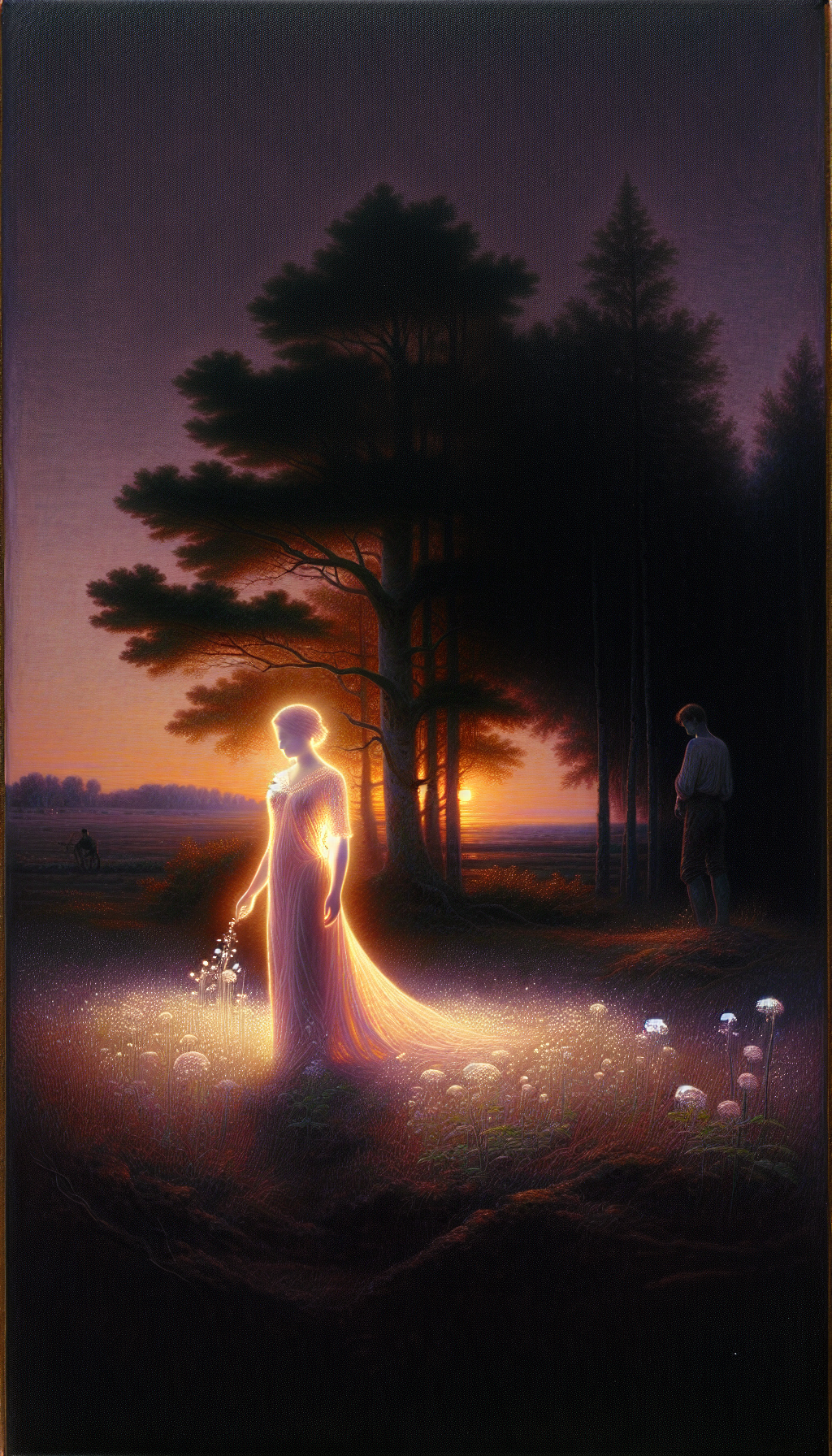
In Spirit in the Field, Layla al-Mir presents a vertical, upright composition that embodies Symbolist Romanticism through an ethereal, painterly style with visible brushstrokes. The focal point is a solitary, translucent figure composed of soft light and spirit, standing in a sun-drenched field at dusk while tending to glowing flowers, their gaze fixed straight ahead. In the background, a ghostly, faint second figure of a man watches from the edge of a dark forest, creating a haunting contrast between presence and memory. The sky is a wash of deep orange and purple, evoking the twilight mood of Romantic painters like Caspar David Friedrich. Through the interplay of spirit, nature, and the liminal boundary between life and the afterlife, al-Mir crafts a scene that is both serene and melancholic, inviting contemplation of the unseen forces that linger in the landscape.